


The moment I entered the upstairs gallery of New York’s Art Students League and saw the close-up portrait of a young man, I knew I wanted him. After seeing the work, I felt a duty still to look at the many other paintings for sale at the League’s annual Christmas show, all set randomly, salon-style, to display as many as possible. But as I roamed the room, I was distracted, unable to really see any of the others because what I had seen first remained in my vision. I had already decided on what, and with whom, I wanted to live.
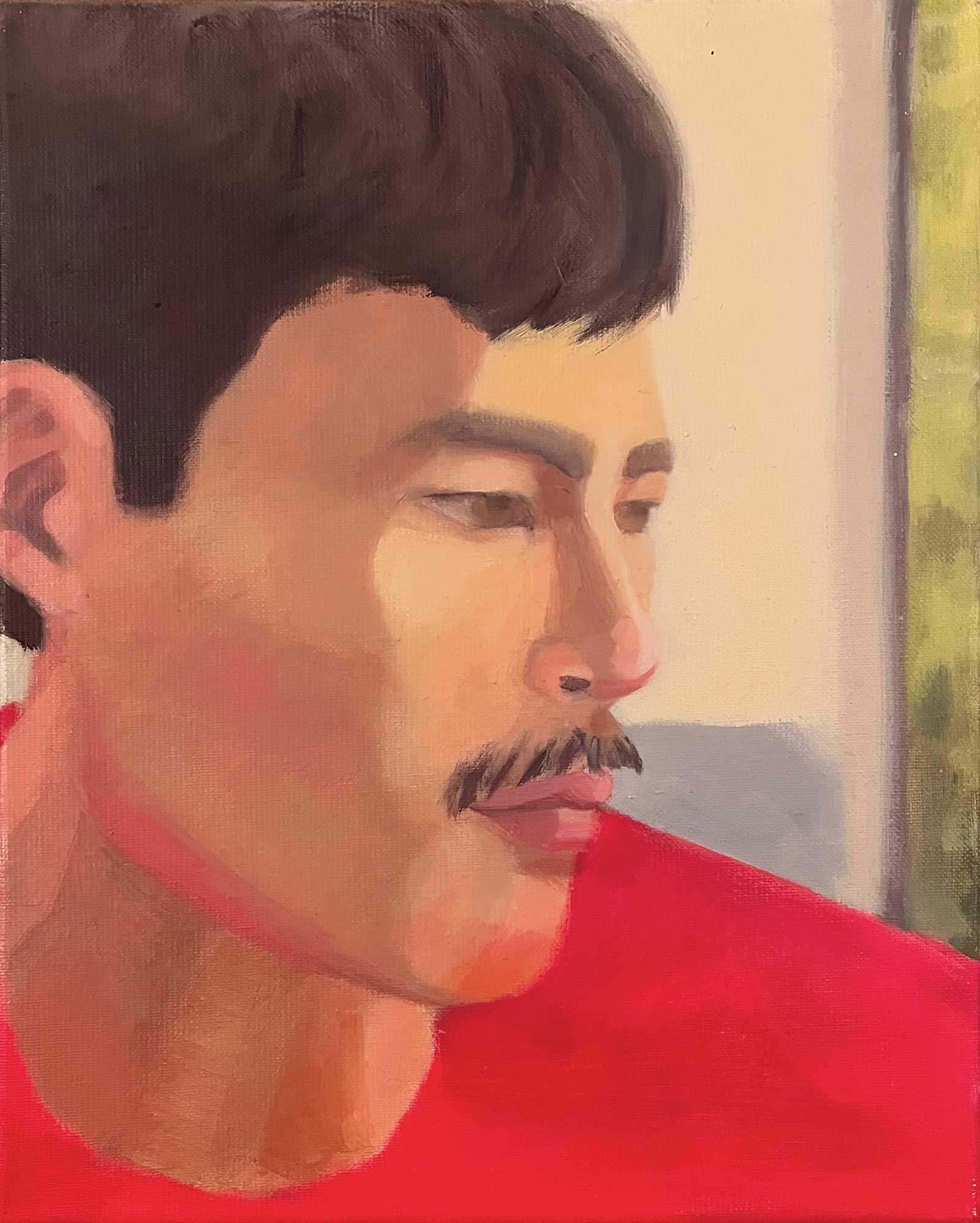
The untitled portrait by an unknown artist (oil on canvas, 11 x 14") that David Masello purchased from the Art Students League in their December 2024 holiday show, and is at the heart of this story.
The woman in charge of the gallery carefully wrapped the painting in brown packaging paper, securing the seams with tape, as my $500-plus payment processed. Upon completion, she said, “This is the hollow side,” indicating the back of the stretcher, “the safer side.”
On the long walk back to my apartment, I stopped to buy dinner fixings at a Trader Joe’s, a busy late Saturday afternoon, and worried that the work could be damaged—by people bumping into it or having something fall on it in my cart. As the young cashier was bagging my groceries, I told her about the painting I was cradling under an arm.
“Hang it well,” she called out to me as I walked away.

Tim Kennedy, June, oil on linen, 48 x 56"
I continue to be startled by the piece, the figure’s face reminiscent of something by the figurative painter Alex Katz—like his people, far larger than life-size, minimal in the detailing, yet still conveying much about character, beauty and age. My handsome figure, who appears to be Eurasian, wears a red T-shirt, a powerful shade of the color that is at once cheerful and bold, and one of the only flashes of that hue to appear anywhere in my apartment. I tried the work out in various spots—swapping it with another new figurative work by Spanish artist Ale Casanova I bought weeks ago that hangs over my TV. Holding it in place on the wall behind the couch where I have a large salon-like assemblage of portraits. Setting it on an end-table. Eventually, I hammered a hook into a wall and positioned the work, which measures a mere 11 by 14 inches. I decided early on to keep it in the living room so I could see him for more of the day, and for more visitors to do as well.
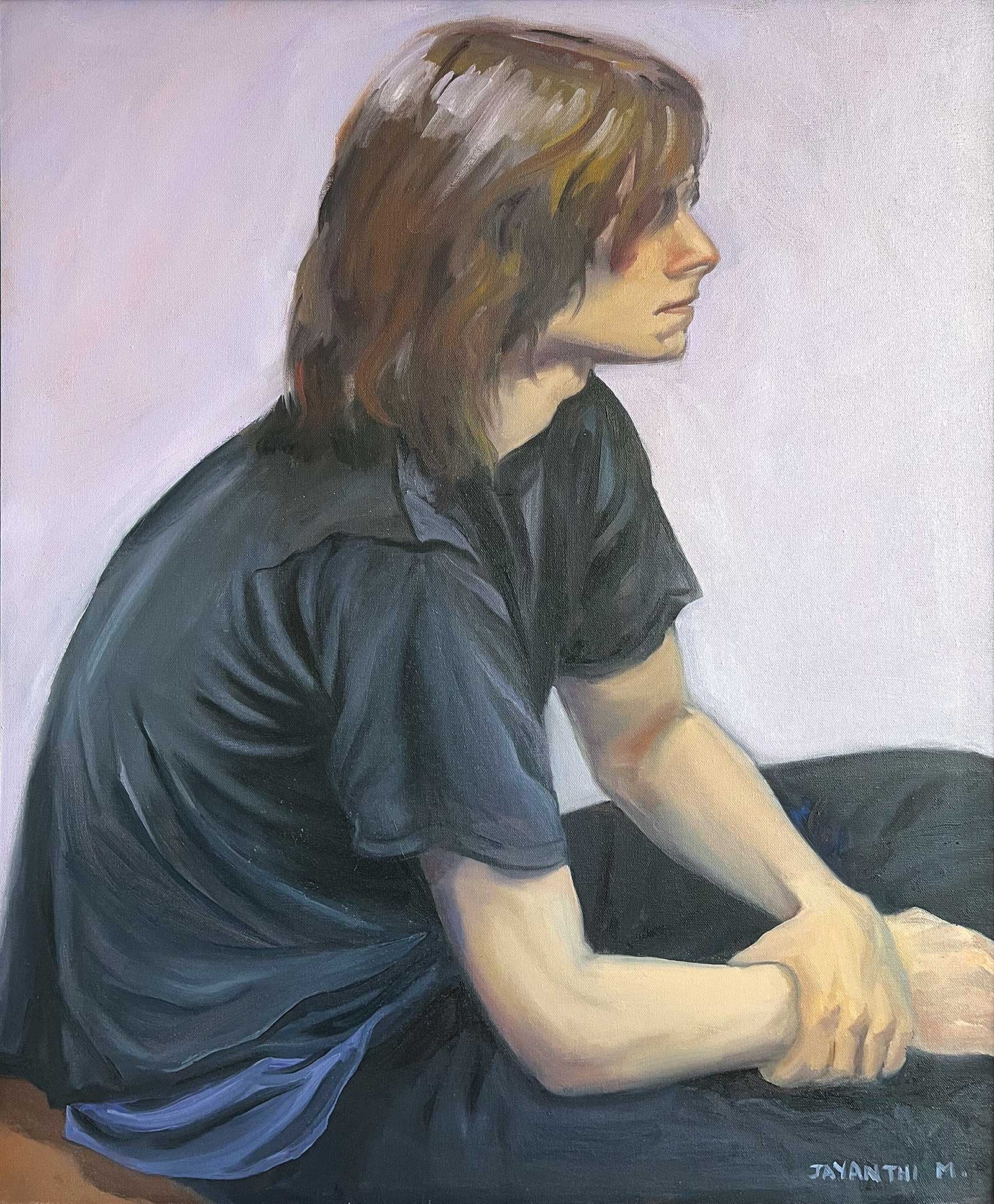
Jayanthi Menon, Portrait of a Young Man, oil on canvas, 24 x 29”
The artist’s signature appears nowhere on it, a disappointment. As is the procedure for any of the League’s weekly exhibitions where works are for sale, I filled out a purchase form that asks if you, the buyer, are okay with having the artist contact you. I have filled out such forms before, and I have always heard from those artists, even becoming friends with them: Jayanthi Menon, who at the time I met her, was the wife of a prominent United Nations ambassador from Singapore; a retired man named Joseph Lovalvo, from Long Island, who has since died (both of whom told me that I was the first person to buy a work of theirs); the prolific portraitist Elsasser Michael, who lives across from Morningside Park and invited me to roam the rooms of his expansive apartment to see his other works.
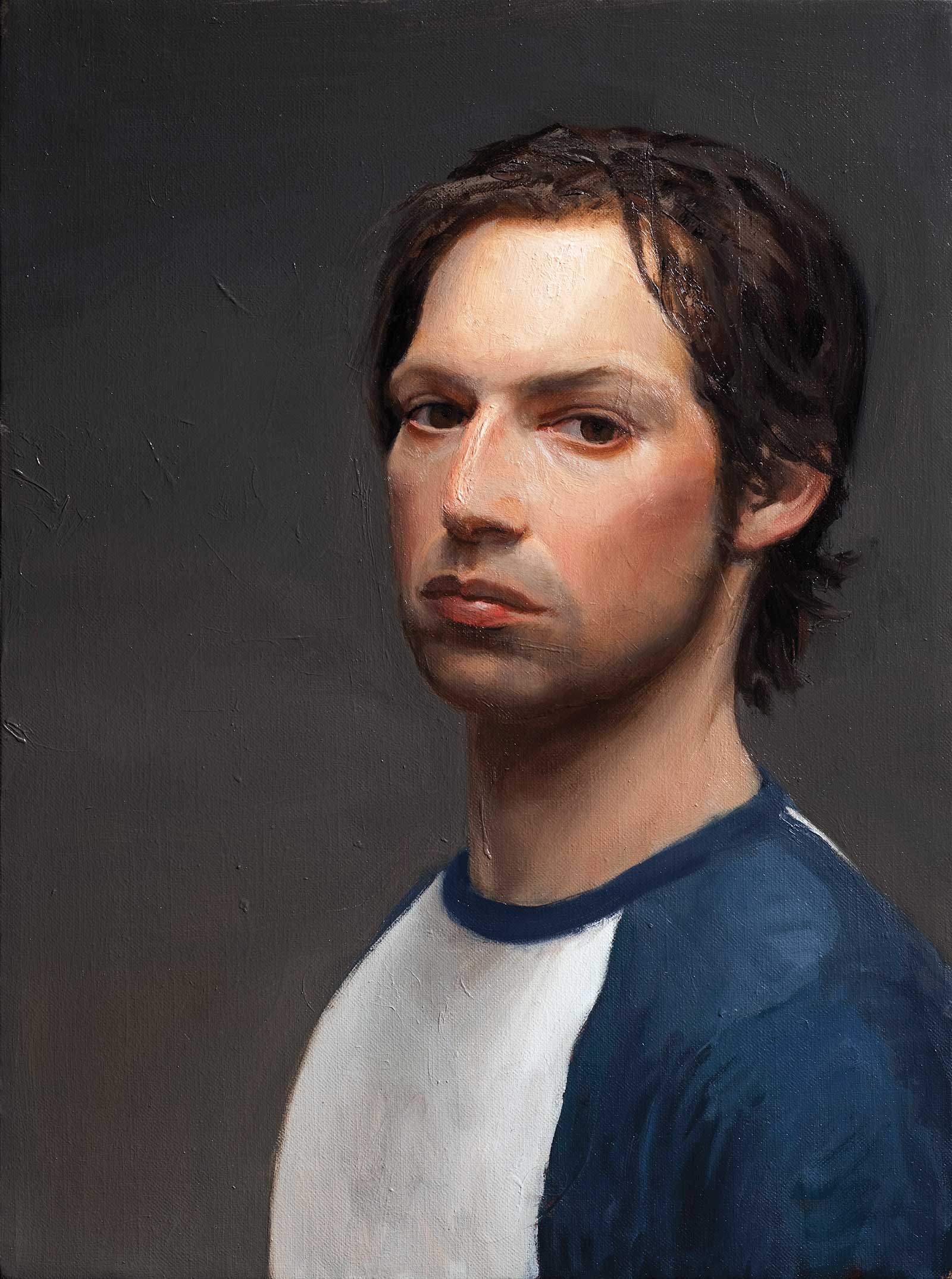
Kenny Harris, Self Portrait, oil on canvas, 16 x 12"
These many days later, I have yet to hear from the painter of this portrait and, oddly, I feel as if I’ve asked someone out on a date who declined. I had been hoping to convey to the artist my admiration for her well-groomed young figure, looking contemplatively to the side, out a window that is hinted at more than shown. He has grown a short, neat mustache that hovers over the full lips of a young man, his black hair scrolls across his forehead and a rectangle of a sideburn inches halfway down his ear. Just enough sunlight stencils onto a portion of his face to indicate he is gazing through a window.
Because the stretcher is so thick, some of the composition is lost as the canvas wraps the edges. Portions of his head appear askew onto the sides, as if the painting is meant to be a three-dimensional object. More of the mottled spring greenery to which he looks through a window spills over the stretcher edge, as well as his red shirt and curl of an ear—and I wonder why the artist chose not to have her composition appear in full. I will keep the work unframed, as I do most of the paintings I own, for this very reason—I want as much of the figure as I can have. To contain it in a frame would mean losing those additional elements of him. I am always intrigued by what an artist is willing to sacrifice to the edges of a stretcher.
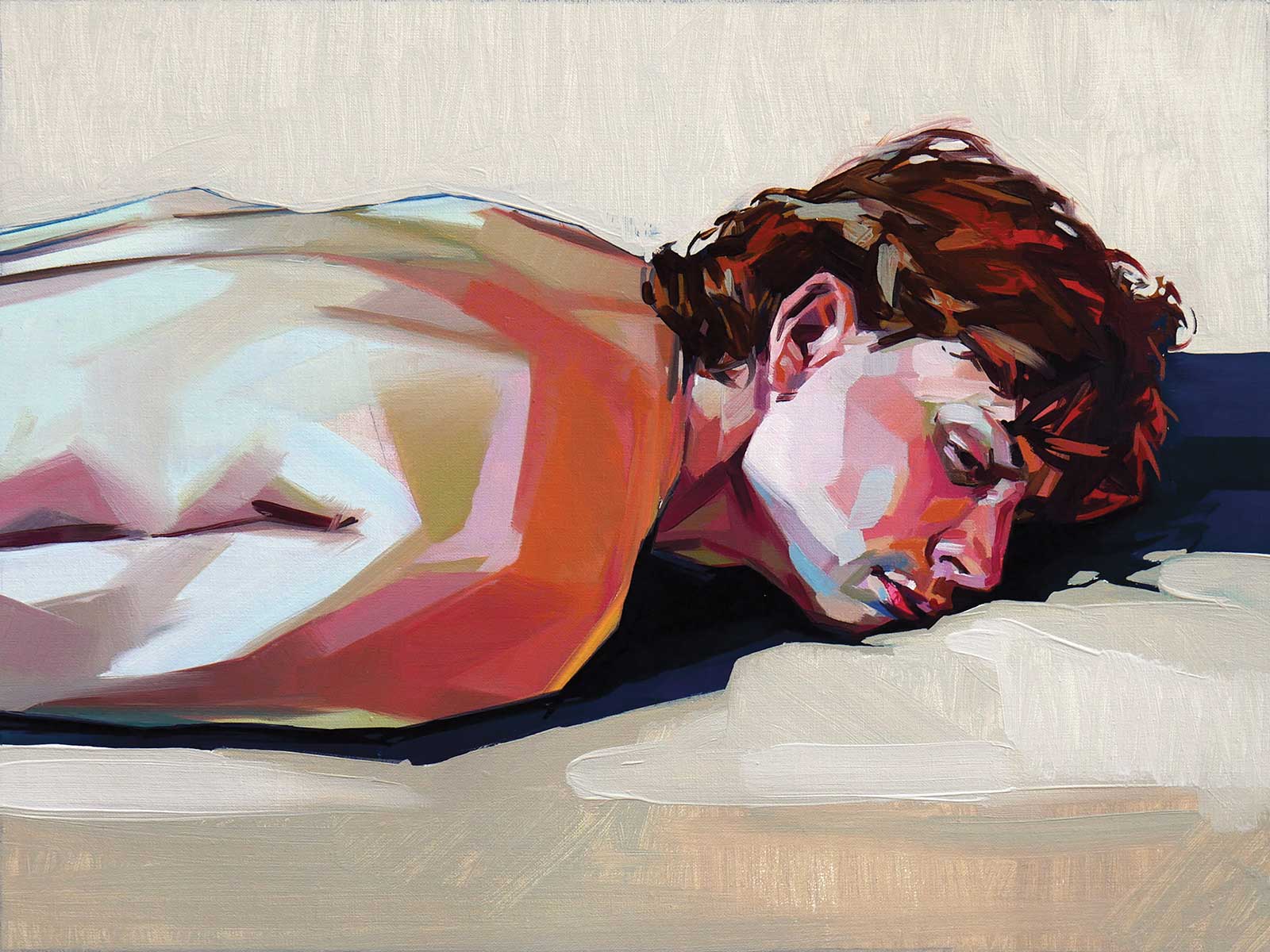
Ale Casanova, After Tension, oil on canvas, 12 x 16"
When I look at the many figurative paintings I own (roughly 19), most are attractive young men, and only a few of these people look directly at you. Instead, their heads are cocked, as they gaze into the distance, some posed contrapposto, each engaged in thought. Young attractive figures, real or painted ones, who are immersed in apparent reverie, appeal to me, for it means that they are imbued with a sensitivity that can elicit love. Mary Connelly’s young man leans on a bed in her work entitled Echo Park, Tim Kennedy’s young figures occupy Craftsman-style houses in Bloomington, Indiana; and the one reproduction painting I own, an image by Jean Alaux shows a young man perched on his bed, strumming a guitar, circa 1817, as he looks through the shutters of his room at the Academie Francaise in Rome.
Every time I bring a new portrait into my apartment, it feels as if I have brought an actual living person inside. I have a loving, ever-curious, 88-year-old Aunt Jo, who lives in suburban New Jersey, someone I talk to nearly every day, and with whom I can be totally frank, as she is with me, especially on matters of sex and romance. She used to paint still lifes and landscapes in her family room and was excited to hear about my latest purchase.
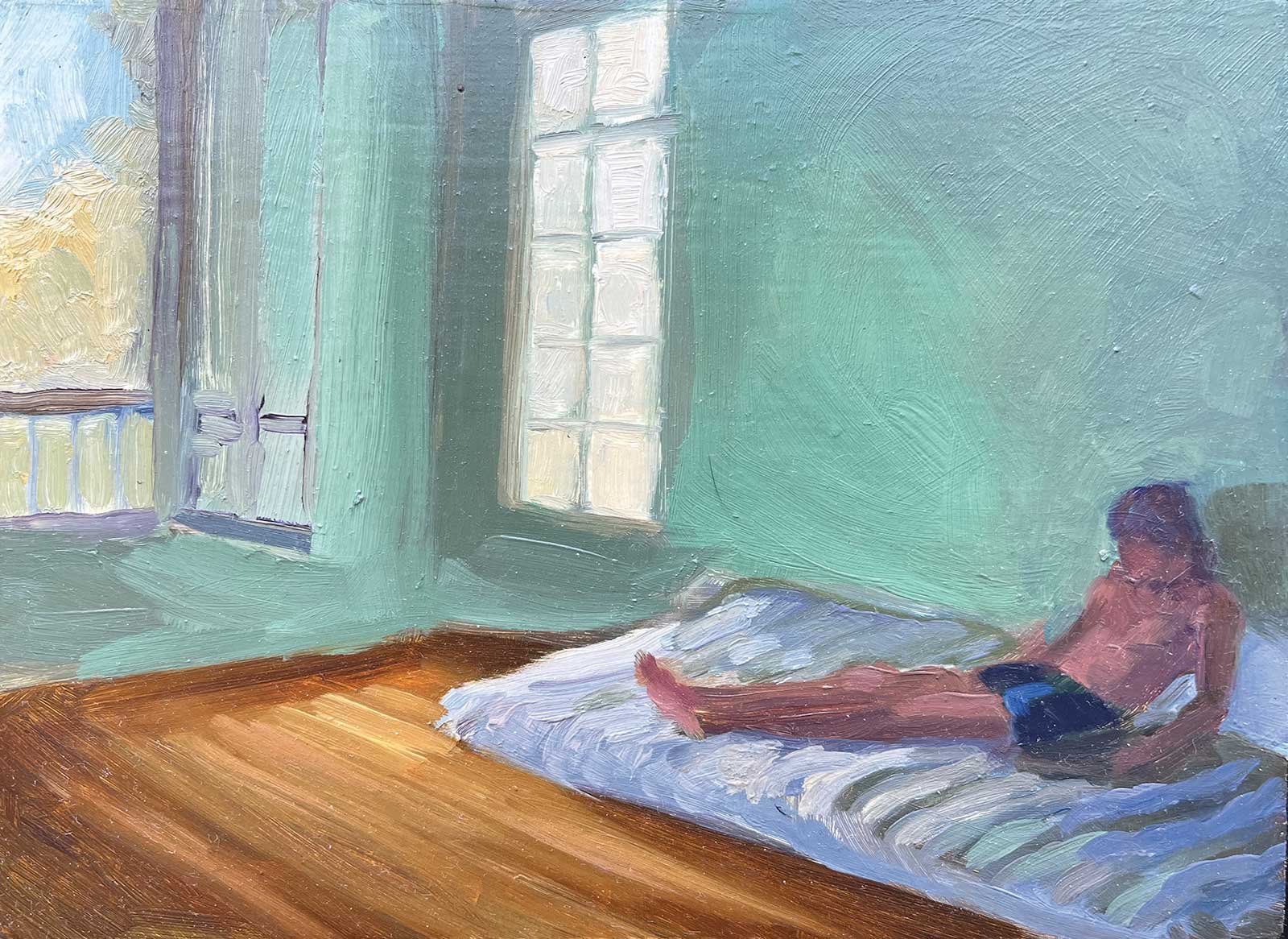
Mary Connelly, Echo Park, oil on panel, 6 x 8"
“Describe it to me, sweetheart, and who it shows,” she asked. “Wait, wait, before you answer, I can guess—another young man. You do like your young men.” And after a moment’s pause, she added, “They’re good people to live with.”
As satisfying as it is to have a new work hammered in place, I also hesitate in doing so for a few days because I like to carry the figure with me throughout my one-bedroom apartment. I’ll prop it on a chair as if the figure is actually visiting with me. I’ll set it on an end table, swap it with another work already hanging, even lay it flat on my dining table as I eat breakfast so that I can hover over it. When it is beside me in that way, the figure is closer than it would be on a wall. I can smell the paint and see details I might not be able to discern once it is hung beyond eye level.
There is the privilege, too, that comes with owning a painting rather than admiring one in a museum or gallery or in someone’s home. This painting is mine. I can touch its surface with no reprimand, no alarm will sound. I can feel the tack of the paint, brush the raw-wood stretcher and risk a splinter. I can test the tautness of the hanging wire and tighten it with a haughty twist if I wish.
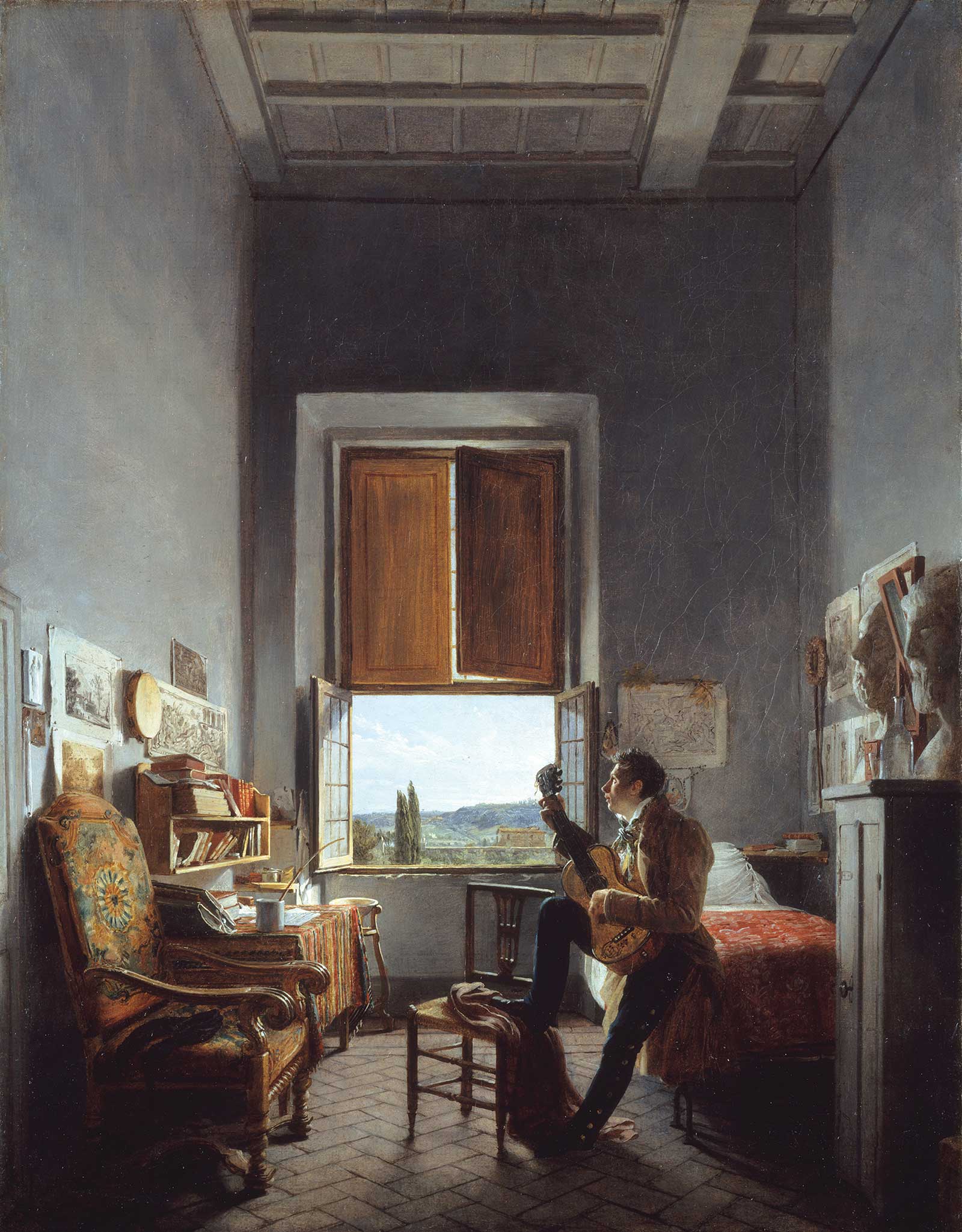
Reproduction of Jean Alaux’s Léon Pallière (1787–1820) in His Room at the Villa Medici, Rome, 1817.
Since acquiring the work, I have thought of the artist receiving the news that her work had been purchased by a stranger, and how that fact had to have brought her pleasure and satisfaction, knowing that a man walked into the gallery one afternoon and purchased what she made. That she did not sign it, however, makes me question whether she was happy or satisfied enough with the finished work. Maybe she thought it imperfect, not worthy of her signature. Years ago, I used to make a weekly pilgrimage to a woman who operated a booth at a Sunday flea market in the Art Deco lobby of the Williamsburg Savings Bank. She represented a consortium of fellow young artists who painted works with no signature, and I wondered why any artist would work so hard, reveal his or her talent, and not want a name credit for having done so. I bought five works from her on a single day—four highly detailed Brooklyn cityscapes and another that shows a fragment of a skateboard and its rider casting a long diagonal shadow. They are among the first works anyone sees upon entering my apartment, and while people often comment on them, I am unable to cite their makers. I rightly predicted that her business would not last because the artists, upon seeing how quickly their works sold for less than $100 each, would resent working anonymously.
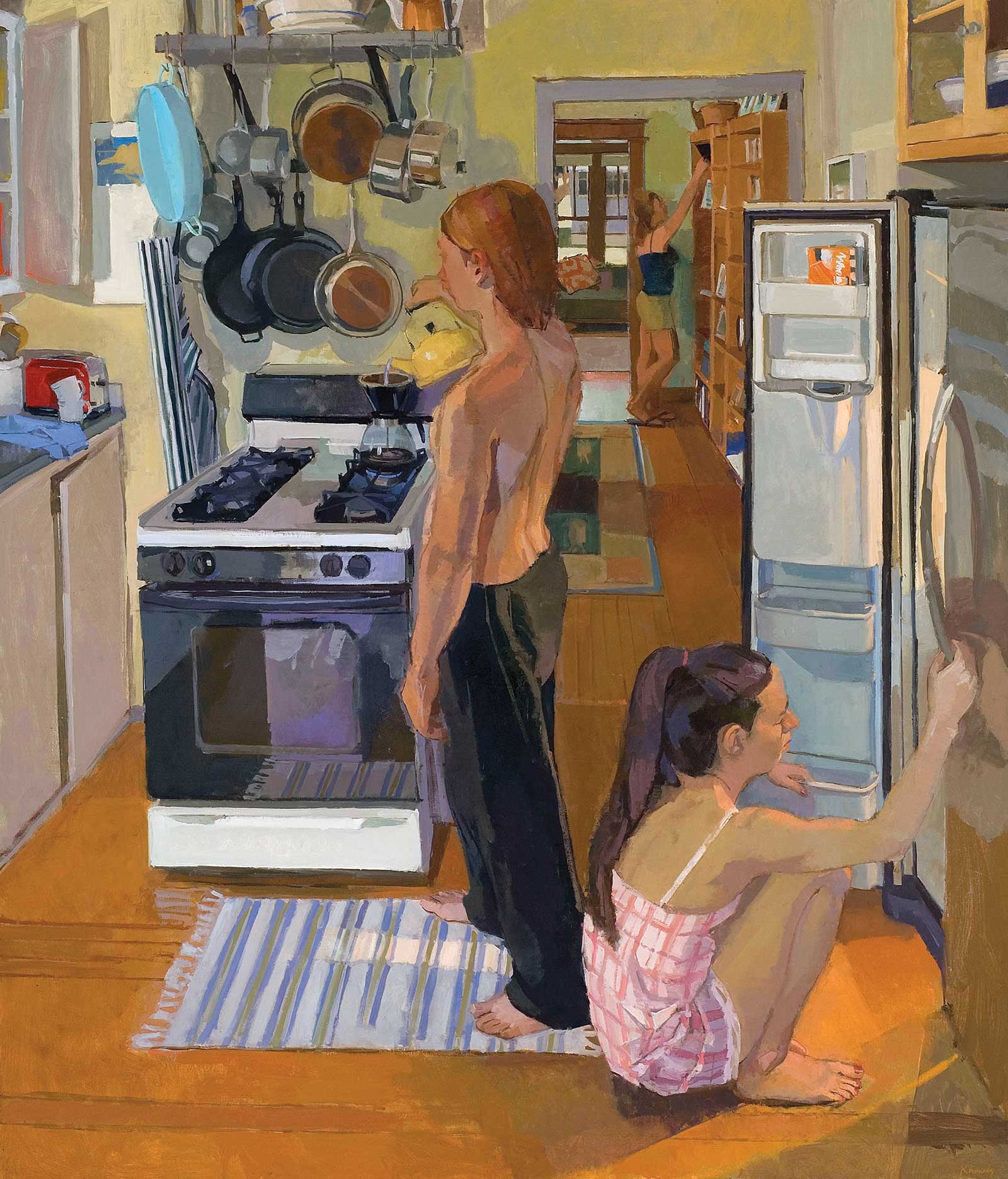
Tim Kennedy, Getting Up, oil on linen, 56 x 48"
The red of my new figure’s shirt bleeds not only onto and over the edges, but as I have discovered this morning, also onto my white wall, indicating that the painting was just days, or hours, off its easel when I purchased it. In that sense, the figure feels like a living entity, signifying the life of a young man, in thought, on a warm sunny day, his face still unmarked by age. I’ll continue to age as he remains the same age. Such is the dynamic of owning a portrait of a young and beautiful stranger who is here to stay. —
+++
David Masello writes about art and culture from New York. His essays have been widely published, and he also writes one-act plays that have been performed by numerous companies in New York and Los Angeles. A selection of his works can be found at davidmasello.com.
Powered by Froala Editor